
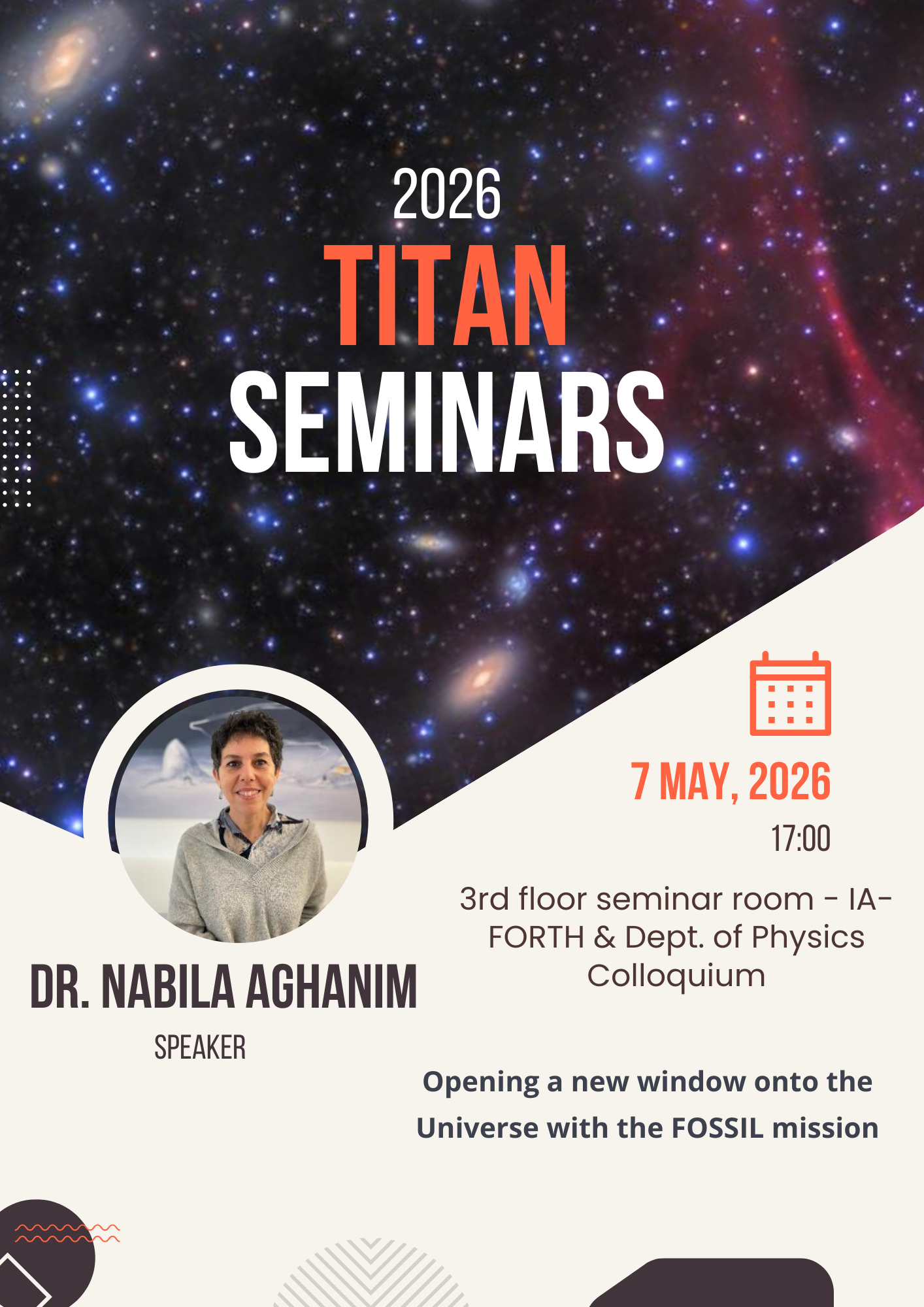
Speaker: Dr. Nabila Aghanim (Université Paris-Saclay, France)
Title: Opening a new window onto the Universe with the FOSSIL mission
Date: 2026-05-07
Time: 17:00-18:00
Lcation:
3rd floor seminar room - IA-FORTH & Dept. of Physics Colloquium
Zoom Link
Abstract: The Cosmic Microwave Background (CMB) is a pillar of modern cosmology. Since the results of the COBE/FIRAS satellite in the nineties the CMB spectrum is known to be a quasi-perfect blackbody. However, both standard and non-standard physics processes inevitably lead to deviations from blackbody, named spectral distortions. They provide a unique opportunity to reveal novel probes of the early Universe, particle physics, and structure formation. The presentation will cover an ongoing effort to design and fly the FOSSIL mission, in answer to the European Space Agency M8 call for proposal, a future satellite aimed at achieving an unprecedented leap forward in sensitivity, allowing us to revisit the measurement of the CMB spectrum and to detect these spectral distortions.
Speaker Bio:Nabila Aghanim is an astrophysicist and cosmologist at the Institute of Space Astrophysics (IAS - Université Paris-Saclay, CNRS). In an ongoing dialogue between theory, modelling and instrumentation, her mission is to predict the models of the cosmos to be studied, and then to analyse the data proceeding from space telescopes in the major international programmes. What is the end goal? To track down any trace of signals in the cosmic microwave background to learn more about the nature of the Universe and the formation of the first clusters of galaxies.
Since she completed and defended her PhD thesis at the IAS under the direction of Jean-Loup Puget in 1996, Nabila Aghanim has worked on the Planck space telescope project for the European Space Agency (ESA). The telescope measures with great precision tiny temperature variations in the cosmic microwave background - the fossil radiation from the Big Bang 13.7 billion years ago. The mission was finally selected by the ESA in 1996 and the telescope was launched in 2009. "My research was to study the secondary effects of the cosmic microwave background, i.e. everything that has an impact on the fossil radiation signal from the moment it was emitted. I first worked on the scientific predictions of the measurement of the so-called SZ (Sunyaev Zel'dovich) effect, i.e. the trace of hot gas in the clusters that alters the cosmic microwave background." The study of the latter informs scientists about the history of galaxy clusters and the first stars.