
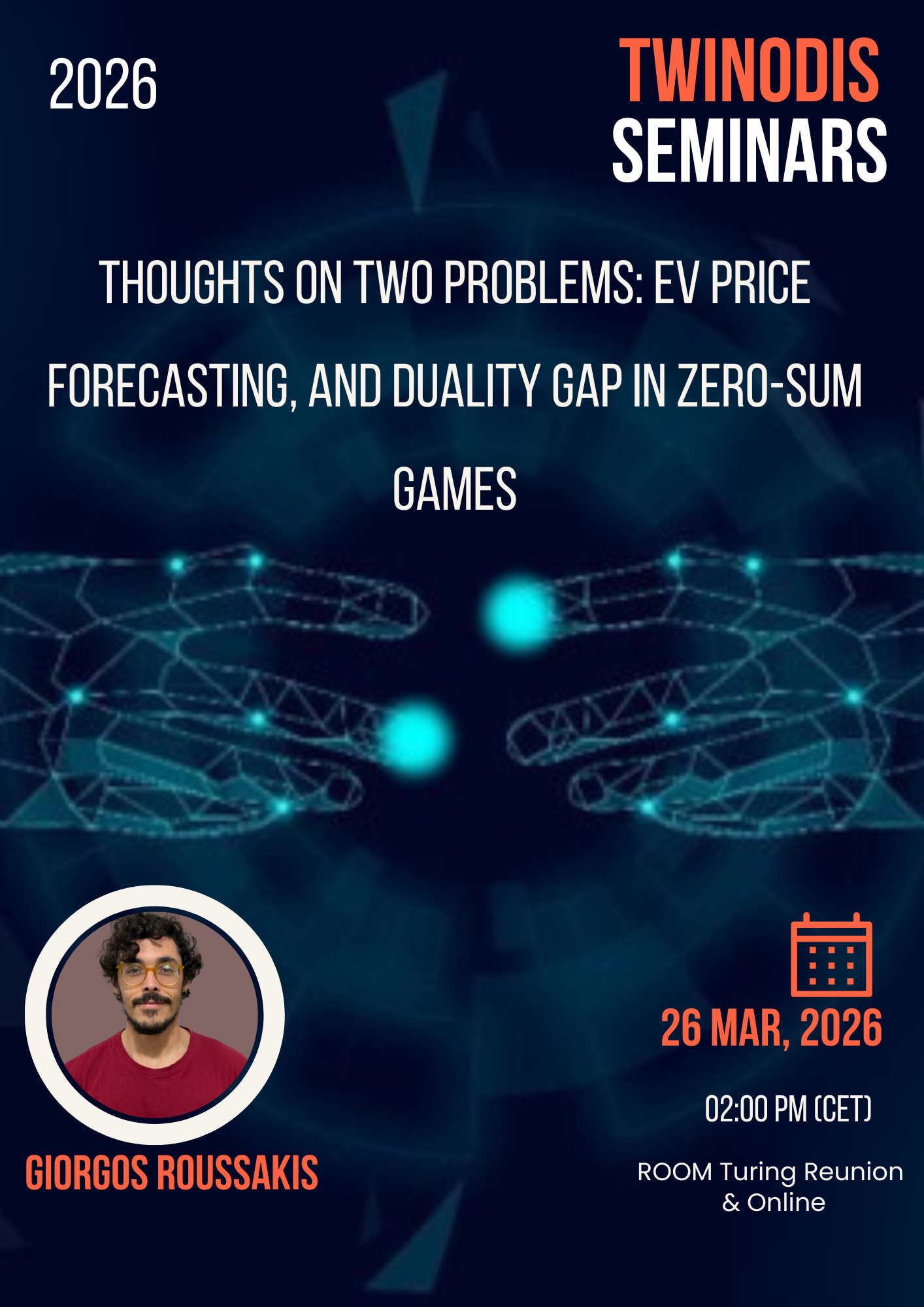
Speaker: Giorgos Roussakis, ICS-FORTH, Greece
Title: Thoughts on Two Problems: EV Price Forecasting, and Duality Gap in Zero-Sum
Games
Date: 2026-03-26
Time: 14:00-15:00 (CET)
Location: Online
Host:Themis Palpanas, UPC
Abstract:
The first part of the seminar introduces an adaptive framework for electricity price forecasting specifically tailored for electric vehicle charging optimization by integrating multi-day exogenous forecasts and rolling window training schemes. This research addresses the practical limitations of existing models that often assume perfect knowledge of future variables, such as renewable generation and grid load, which are typically unavailable beyond day-ahead horizons. To overcome this, we implement a dual-stage pipeline that trains on calibrated noise applied to historical data to reflect real-world uncertainty and utilizes rolling window retraining to better handle market non-stationarity and seasonal shifts. By applying probabilistic methods such as Distributional Deep Neural Networks and Lasso Quantile Regression Averaging, the system effectively hedges against price volatility, ultimately reducing consumer costs by significantly outperforming naive charging strategies in real-world market conditions.
In the second part of the seminar, we present a specialized learning algorithm designed to solve zero-sum games by focusing on the minimization of the duality gap through a descent-based methodology. Instead of traditional methods that may oscillate during the optimization process, this approach treats the duality gap as a direct objective to be minimized, iteratively learning strategy profiles that reduce the gap to reach a stable Nash equilibrium. This descent-based learning framework provides a mathematically rigorous path to solving complex games by ensuring that the distance between the primal and dual solutions is consistently reduced, making it particularly effective for large-scale strategic environments where traditional gradient- based heuristics might fail to converge efficiently.
Short bio:
Giorgos Roussakis holds an MEng in Electrical and Computer Engineering from the National Technical University of Athens and an MSc in Computer Science from the University of Crete. He is a Research and Development Engineer at the Institute of Computer Science, Foundation for Research and Technology Hellas (ICS-FORTH), working at the Signal Processing Laboratory (SPL). His research spans algorithmic game theory, optimization theory, and machine learning. His work on two-player zero-sum games includes a descent-based method that directly minimizes the duality gap, a convex function for bilinear games, achieving geometric convergence rates and competitive performance against state-of-the-art solvers such as OGDA, published at IJCAI 2025. He has also contributed to the convergence analysis of Forward Looking Best-Response (FLBR), a Multiplicative Weight Update(MWU) method, establishing new rates for a method previously known only to converge asymptotically, with results under review. On the applied side, his work on adaptive electricity price forecasting integrates realistic multi-day exogenous variable pipelines and rolling window retraining to improve both forecast accuracy and downstream EV charging optimization.