PIML Workshop Coming to ICS-FORTH in September 2026
Online Participation
Participants joining remotely can connect to the PIML Workshop through Zoom. You can also download the workshop iCalendar (.ics) file and import it into your calendar.
Passcode: 322344
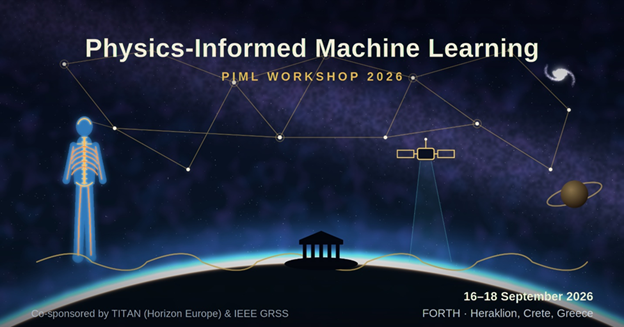
The Workshop on Physics-Informed Machine Learning will be held from 16–18 September 2026 at the Foundation for Research and Technology – Hellas (FORTH), Heraklion, Crete, Greece. The workshop brings together leading researchers working at the intersection of machine learning, inverse problems, and physics-based modelling, with applications in Earth observation, medical imaging, and astrophysics. The event is co-sponsored by the EU TITAN project and the IEEE Geoscience and Remote Sensing Society (IEEE GRSS) .
Venue & Getting to FORTH
PIML Workshop · 16–18 September 2026
The workshop will take place in the Dougalis Room at the Foundation for Research and Technology – Hellas (FORTH) campus in Heraklion.
Vassilika Vouton, GR-70013
Heraklion, Crete, Greece
Heraklion Airport → FORTH: about 15–25 minutes
Times vary with traffic and transport mode.
From Heraklion city centre, allow about 20 minutes; a typical fare is around €15–20. From Heraklion Airport, allow approximately 15–25 minutes; a typical fare is around €20.
Use Bus 8 or Bus 11. The trip from central Heraklion is typically about 25–30 minutes. Bus 11 serves the University Hospital area and stops a short walk from the FORTH entrance; Bus 8 reaches the FORTH campus on scheduled services.
Once at FORTH: Dougalis Room
Follow the route shown below from the central FORTH building area.
After arriving at the FORTH campus, use the route marked in blue to reach the Dougalis Room.
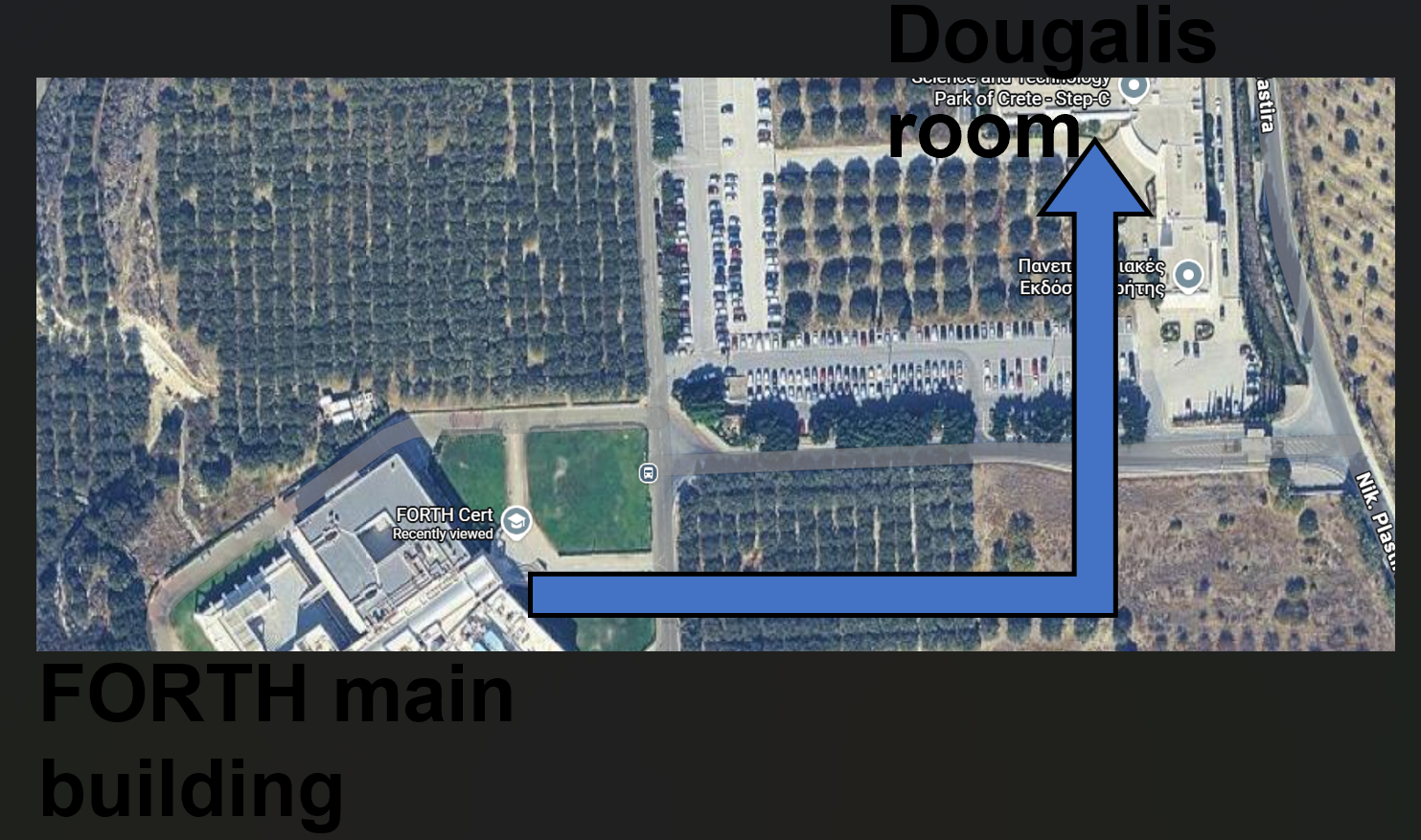
The blue arrow indicates the route towards the workshop room.
Registration Form
Registration for the PIML Workshop is now open. Please complete the form below to register your participation.
Register NowDescription
Physics-informed machine learning represents a rapidly evolving frontier at the intersection of scientific modelling and data-driven methods. By embedding physical laws, governing equations, and domain knowledge into learning architectures, PIML methods offer principled approaches to inverse problems with limited or noisy observations.
Topics of interest include:
- Physics-informed and hybrid AI models for inverse problems
- Deep unrolling and algorithm unfolding for signal reconstruction
- Neural operators and surrogate modelling for PDEs
- Generative models and learned priors for imaging and sensing
- Bayesian inference and uncertainty quantification in physics-constrained learning
- Applications in Earth observation, medical imaging, and astrophysics
Call for Contributions & Submission Guidelines
Dates: 16–18 September 2026
Location: FORTH, Heraklion, Crete, Greece
Participation in the workshop does not require an abstract submission. Researchers who wish to present their work are invited to optionally submit an extended abstract (500 words max) presenting original or recently published work related to the workshop topics.
Organizing Committee
Keynote Speakers
-
Justine Zeghal
Postdoctoral Fellow, Université de Montréal / Ciela Institute / Mila. Her research focuses on machine learning methods for cosmology, Bayesian inference, simulation-based inference, and generative models. -
Ioannis Papoutsis
Head of Orion Lab; Assistant Professor of Artificial Intelligence for Earth Observation at the National Technical University of Athens (NTUA); Adjunct Researcher at the National Observatory of Athens (NOA). -
François Lanusse
Cosmologist and Deep Learning Researcher at CNRS, member of the CosmoStat Laboratory. His work combines machine learning, statistical modelling, and physical modelling for cosmological surveys. -
Florent Sureau
Researcher at CEA-SHFJ, UMR BioMaps. His work focuses on physics-informed machine learning, inverse problems, signal reconstruction, and applications in medical imaging. -
Fabio Del Frate
Professor at the University of Rome Tor Vergata. His work focuses on remote sensing, Earth observation, neural networks, and machine learning methods for geoscience applications. -
Cail Daley
Researcher at Université Paris Cité. His work focuses on machine learning, inverse problems, uncertainty quantification, and scientific applications of data-driven methods.
Important Dates
- Registration opens: Open now
-
Abstract Submission Deadline:
20 July 202630 July 2026 - Conference Registration Deadline: 11 September 2026
Programme
The detailed programme for the PIML Workshop is available below:
View the PIML Workshop Programme
Sponsors
This workshop is co-sponsored by the EU TITAN project (Horizon Europe) and the IEEE Geoscience and Remote Sensing Society (IEEE GRSS) .